
lunes, 14 de septiembre de 2009
Fieltro desde Canadá
Esta es una diseñadora Canadiense Emilie Desmeules que ha incorporado a su producción sacos, sombreros y chalinas de fieltro. Hay una movida muy importante en Canadá asi que en cuanto tenga más material lo iré subiendo para ver el desarrollo que tiene este material allá.


domingo, 13 de septiembre de 2009
Muñecas de fieltro
De regreso después de unas mini vacaciones quiero compartir con ustedes algo de fieltro aplicado a los muñecos. Investigando encontré a esta artista Mimi Kichner que realmente me encanto su trabajo con muñecos en fieltro. Acá les presento una serie de bebés y de señoras que son primorosos, para usar un adjetivo adecuado.
Pronto se vienen los cursos de octubre, necesito unos días para organizarme!!!!
Es lindo irse unos días pero al regreso se junta muuuucho trabajo atrazado

Pronto se vienen los cursos de octubre, necesito unos días para organizarme!!!!
Es lindo irse unos días pero al regreso se junta muuuucho trabajo atrazado

miércoles, 2 de septiembre de 2009
Fieltro:Baltos Kandys II
Hay mucho material de estas artista de Lituania Baltos Kandys. Las primeras imagenes forman parte de una performance donde las artistas, vestidas de blanco, se sientan a comer, en lo que elllas demominan un festin. Luego de esta acción dejan la mesa servida en exposición pero todas la comida expuesta está realizada en fieltro!!!
Nuevamente MARAVILLOSO!!!
Les copie el texto en ingles abajo.
Sigan disfrutando de Baltos Kandys
Performance
Nuevamente MARAVILLOSO!!!
Les copie el texto en ingles abajo.
Sigan disfrutando de Baltos Kandys
Performance
PerformancePerformance
Performance

Video de una performance al aire libre
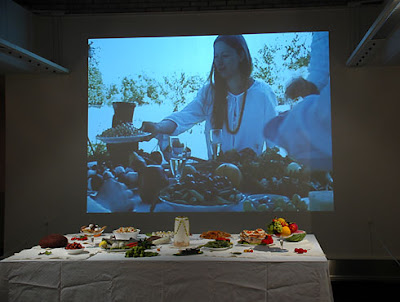
Video de una performance al aire libre
Mesas servida con comida hecha en fieltro


A feast in ancient cultures is an event where people meet together and communicate with their deities. Focused on the “here and now” moment, it has a strong penetrating impact on the people's being. In olden days art and religion were so closely related that they were nearly identical. Indeed it remains unclear whether art may become a sacred deed, or, the other way round, can religion become an art or become dissolved in it?
The ancient community tradition of feasting, which always involves gathering and sharing meals, is being recreated here through the language of art within the Šventė Project. Eating in itself is a very intimate thing, while sharing a meal is an expression of particular closeness. In olden days sharing a meal was also a religious act, as witnessed by a host of meal related rituals and food sacrifice habits.
The sacred atmosphere especially becomes evident in the Video Recording which captures the get-together of the artists themselves. The recording features six women, dressed in white outfits, sitting by the table dressed in white linens and covered with ample of dishes. In the shade of Linden trees, they are sharing food and engaging in conversation. This gathering echoes the venerable tradition when sitting together at the table unified the dead and the living.
The respect to our fathers' traditions focuses our attention on the meaning and value of human relationship. Sharing food is associated with thoughts, energy and information conveyed by artistic means since art is like food nourishes our soul.


A feast in ancient cultures is an event where people meet together and communicate with their deities. Focused on the “here and now” moment, it has a strong penetrating impact on the people's being. In olden days art and religion were so closely related that they were nearly identical. Indeed it remains unclear whether art may become a sacred deed, or, the other way round, can religion become an art or become dissolved in it?
The ancient community tradition of feasting, which always involves gathering and sharing meals, is being recreated here through the language of art within the Šventė Project. Eating in itself is a very intimate thing, while sharing a meal is an expression of particular closeness. In olden days sharing a meal was also a religious act, as witnessed by a host of meal related rituals and food sacrifice habits.
The sacred atmosphere especially becomes evident in the Video Recording which captures the get-together of the artists themselves. The recording features six women, dressed in white outfits, sitting by the table dressed in white linens and covered with ample of dishes. In the shade of Linden trees, they are sharing food and engaging in conversation. This gathering echoes the venerable tradition when sitting together at the table unified the dead and the living.
The respect to our fathers' traditions focuses our attention on the meaning and value of human relationship. Sharing food is associated with thoughts, energy and information conveyed by artistic means since art is like food nourishes our soul.
Etiquetas:
Fieltro en el arte,
fieltro en gastronomía
martes, 1 de septiembre de 2009
Fieltro: Baltos Kandys
El año pasado Andrea Cavagnaro y Soledad Erdocia me mandaron el link de estas artistas de Lituania que trabajan objetos de fieltro para sus acciones performaticas. Son Maravillosas!!! Baltos Kandys, asi es el nombre del grupo, estuvieron en Argentina pero pasaron sin pena ni gloria, desapercibidas, pero vale la pena conocerlas. Estas imagenes pertenecen a la serie de mandalas. Al final copie el texto que acompaña a la serie, pero está en ingles y pido disculpas pero tengo muuucha fiaca de traducirlo, además es muy claro y lindo en inglés.
Reivindico las flores y frutas.


div>


The mandala is one of the most universal models of world arrangement, a principle of the earthly existence. There is a tradition in India, surviving from times immemorial, to draw magic diagrams (mandalas) before the entrance to a house or in places that are considered sacred. Both in tantra and in Buddhism the mandala is used as a meditation object, a ritual of concentration and unification with the divine wisdom. Compositional structure of mandala is not strictly defined, but usually it's a compositional system of repetitive concentric circles and squares; it always represents the bond between the earthly world and the Universe. It's a model of creation of primal existence, it symbolises the link between the time and space, the material and the spirit.
All over the world plenty of mandalas can be found, made in various ways: drawn on silk, carved in wood or metal, cast in bronze or build from stone as temples. Theoretically the symbol itself represents the principle of infinity and constant renewal.
Our visualisation of mandala, created in the context of contemporary art, does not follow canons of any religion, however, it expresses the basic principle of bipolarity of symbols' interaction. This artistic project is every time created live and performed as a ritual before the audience: the artists themselves become a part of their work as they cover themselves and arrange colourful felted objects into a whole that is different every time. After a moment of stillness it dissolves and again blends together and crystallizes into a very clear ornamental composition that complies with the scheme of mandala.
The blending of the individualities of “Baltos kandys” (“White Moths”) group's artists in one mutual work emphasizes the philosophical idea peculiar to the oriental aesthetics, the idea is that everything mixes together and finally follows the same basic principle of the cosmic order. So the creative principles of “Baltos kandys” (“White Moths”) group perfectly resonate the idea of the composition called 'Mandala'. This mandala is not only the map of the Universe, but also a joyful and exuberant expression of the artists' lives and work.
all projects
Reivindico las flores y frutas.


div>


The mandala is one of the most universal models of world arrangement, a principle of the earthly existence. There is a tradition in India, surviving from times immemorial, to draw magic diagrams (mandalas) before the entrance to a house or in places that are considered sacred. Both in tantra and in Buddhism the mandala is used as a meditation object, a ritual of concentration and unification with the divine wisdom. Compositional structure of mandala is not strictly defined, but usually it's a compositional system of repetitive concentric circles and squares; it always represents the bond between the earthly world and the Universe. It's a model of creation of primal existence, it symbolises the link between the time and space, the material and the spirit.
All over the world plenty of mandalas can be found, made in various ways: drawn on silk, carved in wood or metal, cast in bronze or build from stone as temples. Theoretically the symbol itself represents the principle of infinity and constant renewal.
Our visualisation of mandala, created in the context of contemporary art, does not follow canons of any religion, however, it expresses the basic principle of bipolarity of symbols' interaction. This artistic project is every time created live and performed as a ritual before the audience: the artists themselves become a part of their work as they cover themselves and arrange colourful felted objects into a whole that is different every time. After a moment of stillness it dissolves and again blends together and crystallizes into a very clear ornamental composition that complies with the scheme of mandala.
The blending of the individualities of “Baltos kandys” (“White Moths”) group's artists in one mutual work emphasizes the philosophical idea peculiar to the oriental aesthetics, the idea is that everything mixes together and finally follows the same basic principle of the cosmic order. So the creative principles of “Baltos kandys” (“White Moths”) group perfectly resonate the idea of the composition called 'Mandala'. This mandala is not only the map of the Universe, but also a joyful and exuberant expression of the artists' lives and work.
all projects
Suscribirse a:
Entradas (Atom)


